
Turn founder research into a useful file with ChatGPT Work.
Create a source-linked comparison you can review, using a clear brief and a small set of inputs.
ChatGPT Work is an official mode for delegating a task with a deliverable. A useful first founder task is a small vendor comparison: three options, your requirements, and a file that separates evidence from unanswered questions.
Before you begin
Check whether Work is available in your account. You need a signed-in account, the sources you are allowed to use, and enough remaining usage. Work and Codex share usage under OpenAI’s current documentation. Connected services may require their own access. This walkthrough uses public links or files you supply, so installing a plugin is not a prerequisite.
1. Set the outcome and location
Select Work. In the desktop app, choose local work when the task needs files or applications on your computer. Choose Cloud only if it appears and fits the task; the official guide describes it as an option for work that continues without your computer being awake. Do not assume every environment has the same tools.
Our original example: a solo founder wants to compare three support tools for a small product. Start with a short requirements note: expected message volume, team size, integrations, export needs, and a budget ceiling. Do not upload customer records just to compare public pricing.
2. Ask for a reviewable comparison
Create a comparison spreadsheet for the three support tools in my notes.
Use their official product and pricing pages, and record each source URL and check date.
Compare the features I listed, monthly cost assumptions, export options, and unknowns.
Separate published facts from your recommendation.
Use “needs confirmation” when evidence is missing.
Return a draft file for my review. Do not create accounts or contact vendors.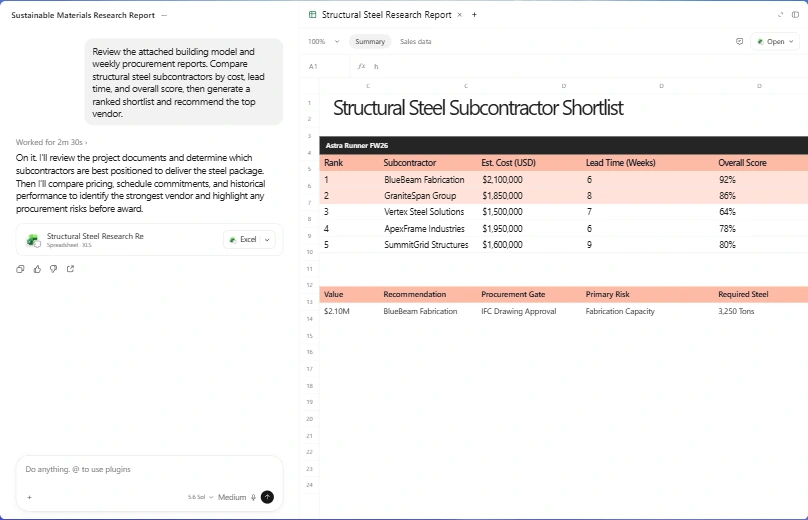
3. Check the cells that affect the decision
Open the result. Pick two important claims and follow their links. Verify that pricing uses the billing period and number of seats you intended. Look for a lower tier being compared with another provider’s higher tier. Missing information should remain visible instead of becoming a guessed zero.
Ask for a revision tied to the file: “The second option requires annual billing. Show the monthly equivalent separately from the amount due upfront.” A specific correction is easier to verify than asking for a better spreadsheet.
4. Turn the comparison into a decision
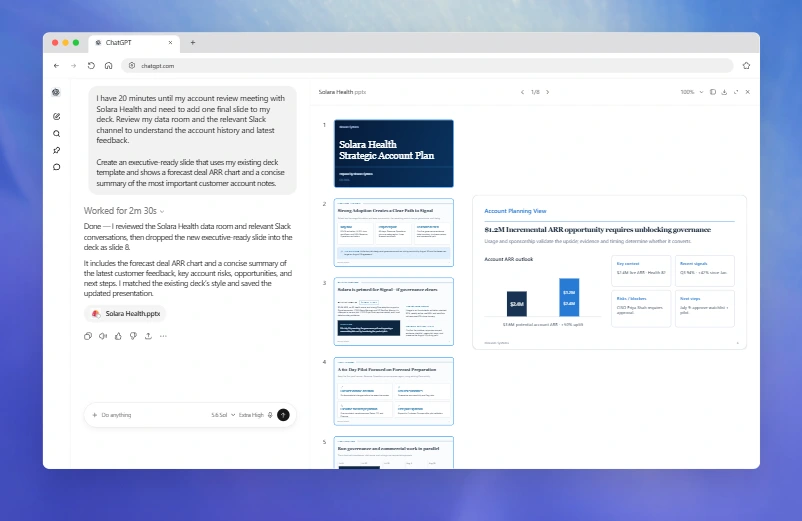
When the table is sound, ask for a one-page brief with your preferred option, the reason, and one remaining question to resolve. You can also request a presentation if you need to discuss it with a cofounder.
What a good result looks like
You can trace each decision-driving claim to a source, change the assumptions, and identify the next action. The file is a draft until you review it. If Work lacks access to a source, provide a permitted copy or narrow the task; do not fill the gap with an invented quote. Long tasks can use more allowance, so complete one bounded comparison before asking for a broad market survey.
Sources & review
Official documentation checked 2026-09-16. Interfaces, access, and limits can change. Screenshots are labeled public documentation captures, not screenshots of your account.